01 — AUTHOR
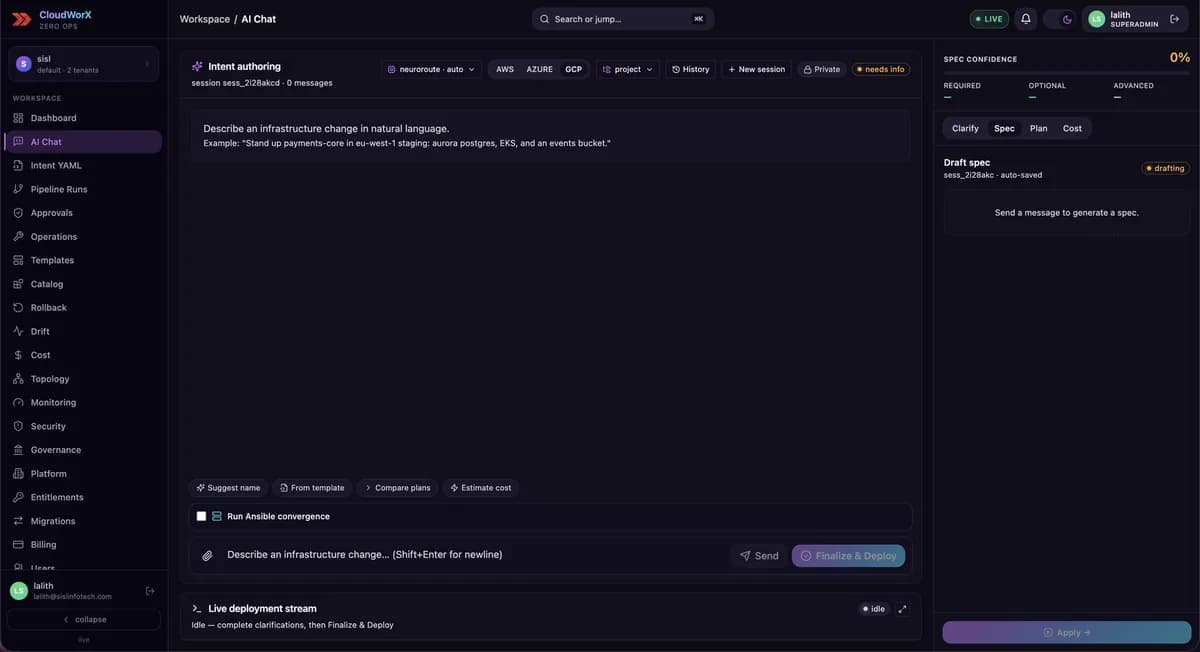
Describe intent. Get a correct plan.
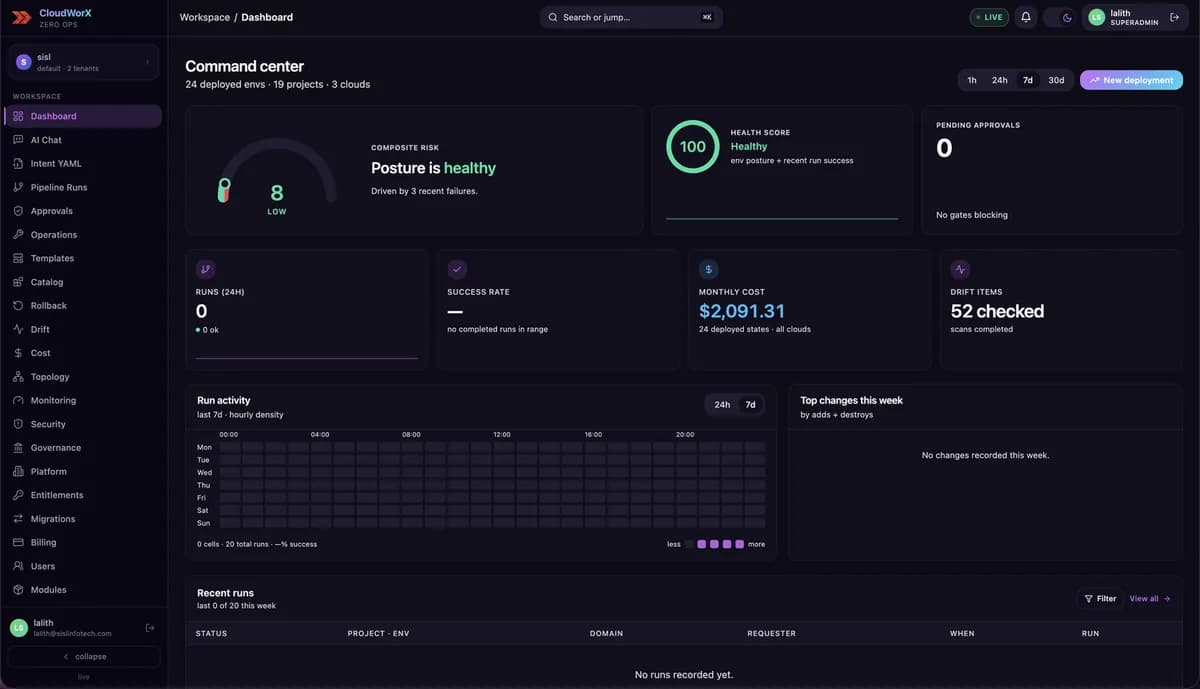
Ambiguity becomes an interactive clarification instead of a silent guess. The model proposes; deterministic code disposes.
Fidelity by construction
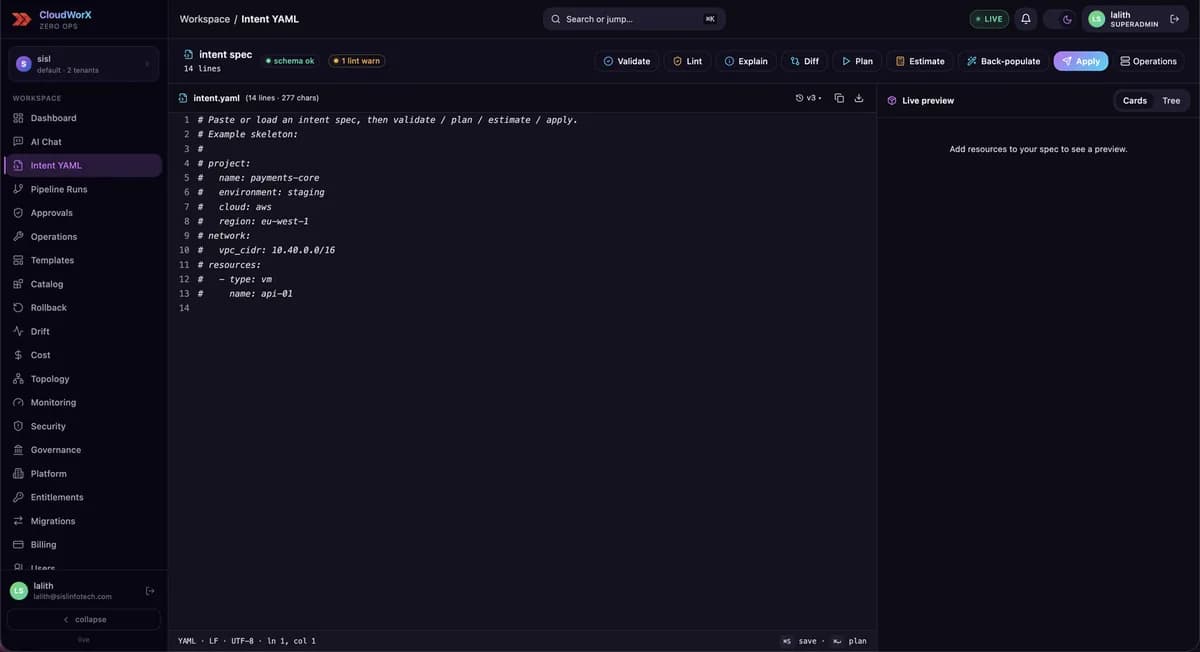
A validator→model retry loop, schema-constrained output and a semantic diff-gate stop a turn from quietly changing a resource you never mentioned.
Templates picker
The assistant selects from a catalog of hand-validated patterns rather than writing raw YAML — there is nothing to hallucinate, and you review the template before use.
Clarify, don't assume
Risky inferences are raised as questions. Spec confidence is shown as it climbs, so nobody deploys a guess.
02 — GOVERN
Nothing ships unchecked
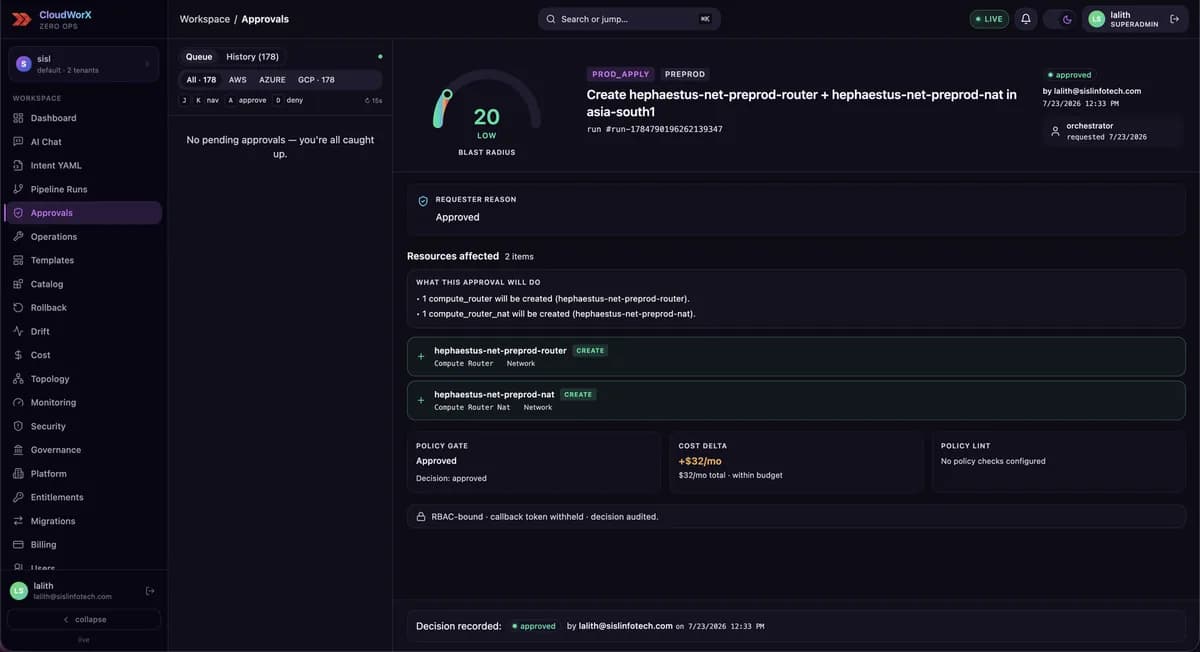
A plan that violates a rule is blocked, not silently applied. A risky change stops at a human gate with the blast radius and the cost delta already on the screen.
POLICY ENGINE
OPA / Rego, plus your own rules
Encryption-in-prod, no-public-ingress and the rest ship built in. Your policies sit beside them and are evaluated the same way.
RBAC + TENANCY
20+ fine-grained permissions
Operator and admin roles, with every tenant and workspace isolated end to end.
APPROVALS
Slack deep-link, full record
Approve or reject where the team already is. The decision, the approver and the diff are kept together.
03 — OPERATE
Apply, watch, and recover
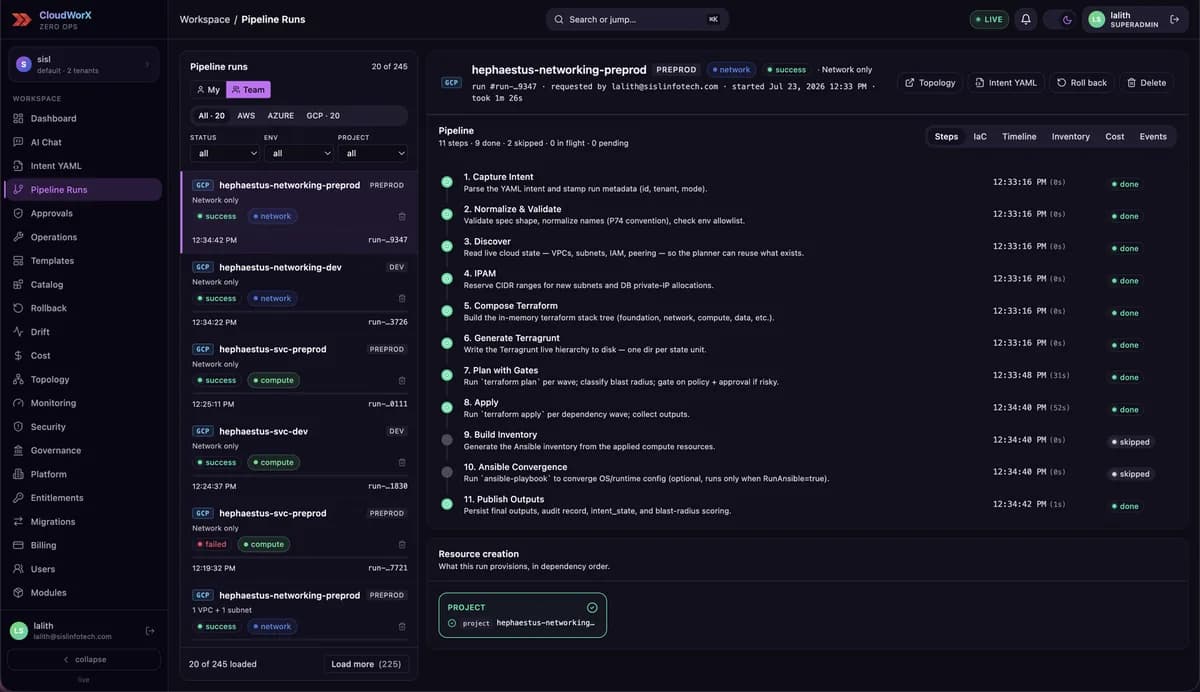
Parse → plan → gate → apply, streamed live. State is locked per scope so concurrent runs never clobber each other, and in-flight work survives a restart.
Day-2 operations
Guided per-resource changes — resize, labels, start/stop, deletion protection — without hand-editing YAML.
Rollback + snapshots
Per-resource rollback backed by state snapshots, so recovering one resource never disturbs its siblings.
Drift + reconciliation
Continuous scans surface drift by severity. Adopt the live change, accept the deletion, or re-converge — each explicit and audited.
Brownfield adoption
Bring existing cloud resources under management with dependency-aware import instead of a rewrite.
One change, end to end
Step through a single request as ZeroOps handles it. ILLUSTRATIVE
APPROVAL GATE
Held until a person says yes
The apply stops here. Not throttled, not queued behind automation — stopped, waiting on a named human with the authority your own rules gave them.
The gate at step four is not configurable away. An estate can be operated fast or operated blind; ZeroOps is built on the assumption that you were asked to prove which one you are.
04 — SEE
One place for the whole estate
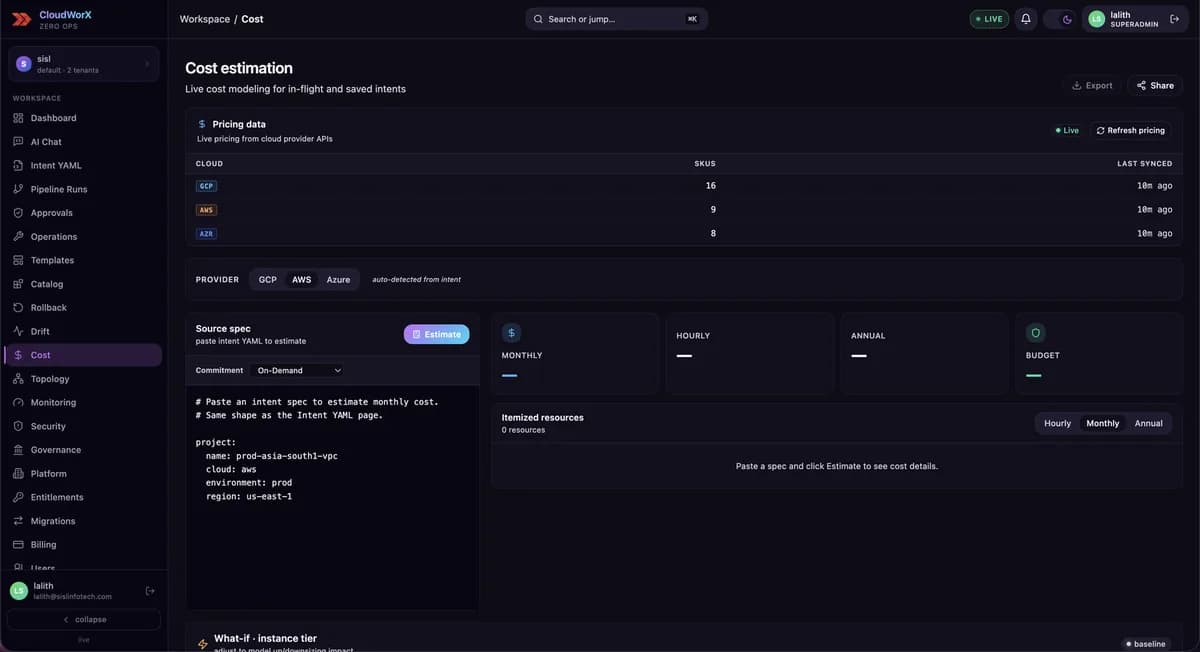
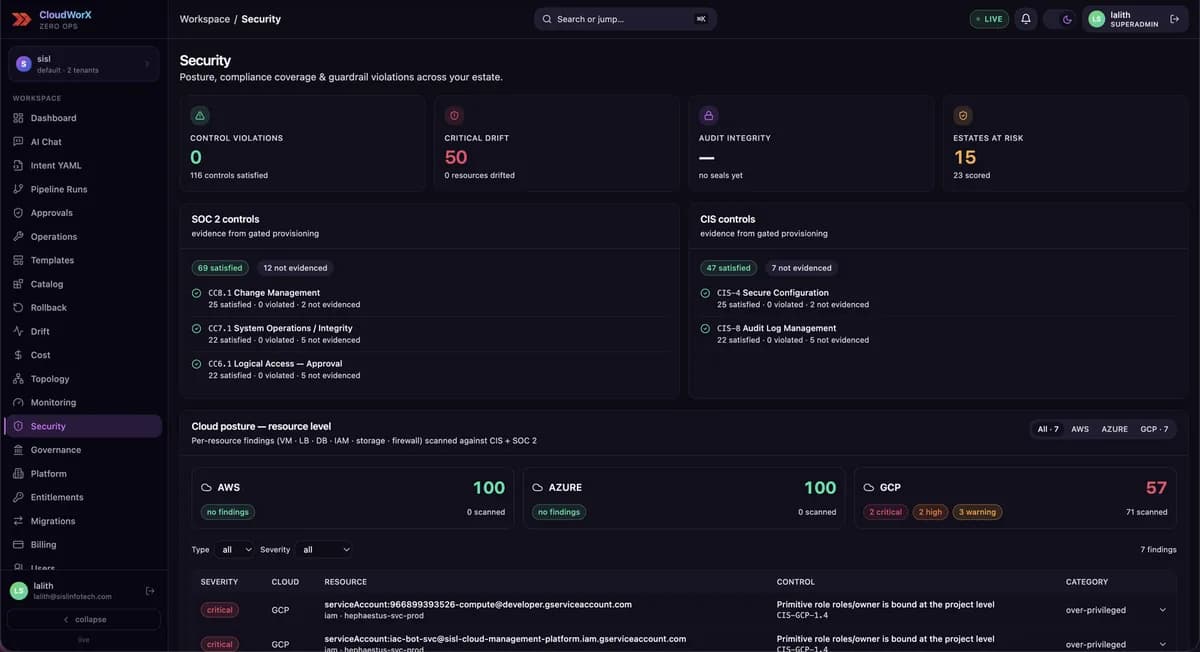
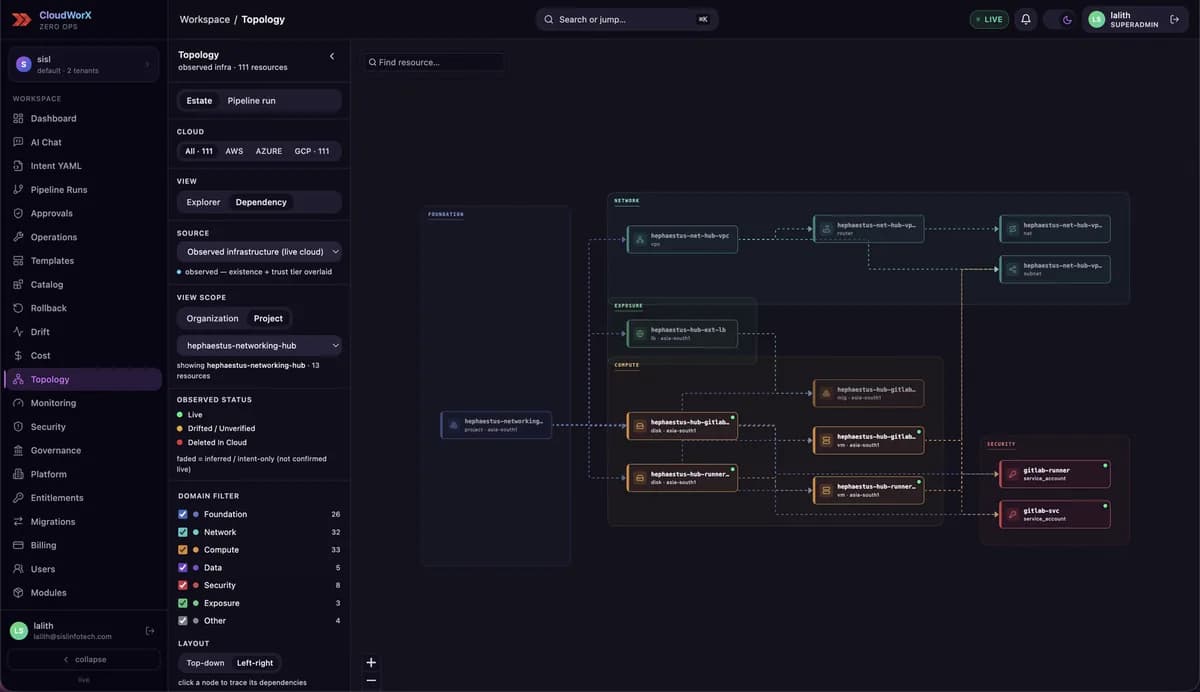
Per-cloud posture scores, a graph of what is actually deployed, and real metric trends with SLOs and error budgets — not fabricated sparklines.
Multi-cloud, first class
Every capability renders for GCP, AWS and Azure. The console groups and filters by cloud everywhere it matters.
RENDER PARITY
Every domain, every cloud
Full render parity across GCP, AWS and Azure — each GCP domain has an equivalent, with cloud chips on runs, approvals, drift and rollback.
CROSS-CLOUD MIGRATION
A readiness report that writes nothing
Each resource is graded — can-render, can-safely-apply, can-migrate-data — and the output is a per-resource data-move plan.
DISCOVERY
Projects, accounts, resource groups
Enumerate what exists per cloud before deciding what comes under management.
Where it runs
Public cloud, and the on-prem platforms an Indian enterprise estate actually contains. Status is stated per platform rather than implied by a logo wall.
The questions we get asked first
Short answers. Every one of them is testable in a walkthrough.
Does ZeroOps replace my platform team?
No. It makes the team you already have faster at the changes they already own. Every apply passes a plan review and a human approval — there is no path where the platform acts alone.
Who owns the Terraform state?
The organisation running the estate. State is held per tenant, locked per scope, and never leaves the environment it governs.
Does this work outside public cloud?
Yes — VMware, OpenStack, OpenShift and Hyper-V are supported today, with Nutanix, bare metal and Proxmox in progress. Status is stated per platform rather than implied by a logo wall.
HARD LIMITS
No automated destroy. No direct cloud mutation from the UI. Every path to the estate goes through a plan, a policy evaluation and a recorded decision.
HOW IT IS SOLD
Direct to the organisation that will operate it. There is no reseller motion for ZeroOps.
WHO OPERATES IT
Your own platform team. ZeroOps removes the queue between a decision and a governed change; the judgement stays where it already is.